
Custom Made Caller ID is a caller identification service that allows businesses and authorized users to manage how their phone numbers and caller information appear on a recipient’s phone. It is commonly associated with business communication, VoIP technology, outbound calling systems, and Caller ID configuration.
When someone receives a phone call, the caller’s number may appear on the mobile or landline screen. In some cases, the recipient may also see a business name or other caller information. This information helps the recipient understand who is calling before answering.
Traditional phone systems usually display the number assigned by the telephone service provider. However, modern communication systems offer different caller identification features that can support business identity and communication management.
This guide explains what Custom Made Caller ID means, how it works, which technologies support it, its benefits, its limitations, and what beginners should understand before using a caller identification service.
What Is Custom Made Caller ID?
Custom Made Caller ID refers to a caller identification configuration that allows an organization to present approved caller information when making outbound phone calls.
Caller ID is the information displayed on a recipient’s phone when someone makes a call. Depending on the telephone network, device, and service provider, this information can include a phone number, caller name, or business identity.
For example, a company may use an authorized business telephone number for its customer support department. When the company contacts a customer, the recipient may see the company’s registered phone number or verified business name.
Custom Made Caller ID is often discussed in connection with VoIP (Voice over Internet Protocol), business phone systems, SIP trunking, and outbound call management.
The exact features depend on the telecommunications provider and the destination network. Not every provider supports custom caller name display, and not every mobile network displays caller names in the same way.
How Does Custom Made Caller ID Work?
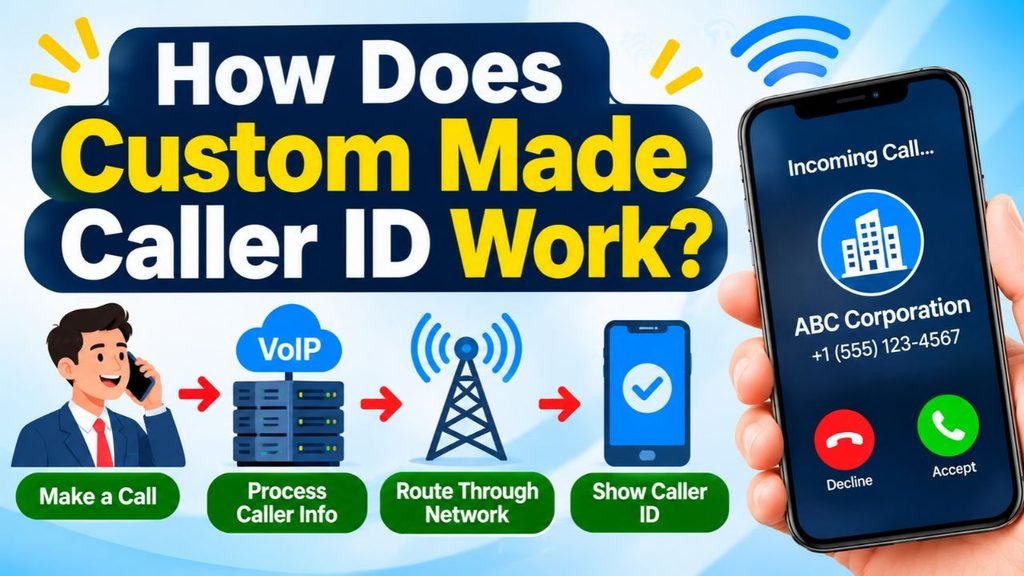
Custom Made Caller ID works through telecommunications systems that transmit caller identification information during the call setup process.
Traditional telephone networks and modern VoIP systems use signaling protocols to establish calls and communicate relevant caller information.
For example, VoIP systems commonly use SIP (Session Initiation Protocol) to establish, manage, and terminate voice communication sessions.
When a business makes an outbound call, the general process involves several stages.
1. Call initiation: The caller starts a phone call using a business phone system, VoIP application, or other supported communication platform.
2. Caller information configuration: The phone system provides the authorized outbound caller number and other supported identification information.
3. Network verification: The originating service provider may validate the caller’s identity and number authorization. In supported networks, caller authentication frameworks can help verify the legitimacy of the calling number.
4. Call routing: The telecommunications network routes the call toward the recipient’s mobile or landline provider.
5. Caller information display: The receiving network and device process the available caller information and display the supported details on the recipient’s screen.
The displayed information depends on the service provider, network configuration, country, and recipient’s device.
What Technologies Are Used for Custom Made Caller ID?
Several telecommunications technologies support caller identification and business calling systems. Understanding these technologies helps beginners understand how modern caller identification works.
VoIP Technology
Voice over Internet Protocol (VoIP) allows users to make voice calls through an internet connection instead of relying entirely on traditional telephone infrastructure.
VoIP is commonly used by businesses, call centers, customer support teams, and remote communication services.
It can support features such as business phone numbers, call routing, call recording, and centralized communication management.
SIP (Session Initiation Protocol)
Session Initiation Protocol (SIP) is a signaling protocol used to establish, manage, and terminate communication sessions.
SIP helps VoIP systems exchange call setup information between communication endpoints and service providers.
It is widely used in business telephone systems and internet-based communication platforms.
CLI (Calling Line Identification)
CLI stands for Calling Line Identification. It refers to the telephone number associated with an incoming call.
The receiving network may use this information to identify the originating telephone number and display it to the recipient.
CLI plays an important role in business communication, telephone network operations, and caller identification services.
CNAM (Caller Name)
CNAM stands for Caller Name. It refers to the name associated with a telephone number in supported caller identification systems.
For example, a recipient may see a registered business name instead of only a telephone number.
CNAM availability and accuracy depend on the country, telecommunications provider, database, and receiving network.
STIR/SHAKEN Authentication
STIR/SHAKEN is a caller ID authentication framework used in the United States to help telephone providers verify caller number information.
It uses digital certificates and authentication information to help reduce illegal caller ID spoofing.
However, authentication does not guarantee that every recipient will see a business name or that every call will be answered.
What Are the Main Features of Custom Made Caller ID?
Custom Made Caller ID services may provide different features depending on the telecommunications provider and the supported calling infrastructure.
Common features include:
Business Caller ID: Displays an authorized business telephone number when making outbound calls.
Caller Name Display: Supports the presentation of a registered or verified business name where the receiving network supports it.
VoIP Calling: Allows businesses to manage internet-based outbound calls through supported communication systems.
CLI Management: Helps organizations manage their authorized outbound calling numbers.
Business Number Configuration: Allows companies to use approved telephone numbers associated with their departments or communication services.
Call Routing: Directs incoming and outgoing calls through configured telephone systems.
Caller Authentication: Supports verification mechanisms that help protect telephone networks against unauthorized caller identification practices.
These features can help businesses maintain consistent communication and make their outbound calling systems easier to manage.
What Are the Benefits of Custom Made Caller ID?
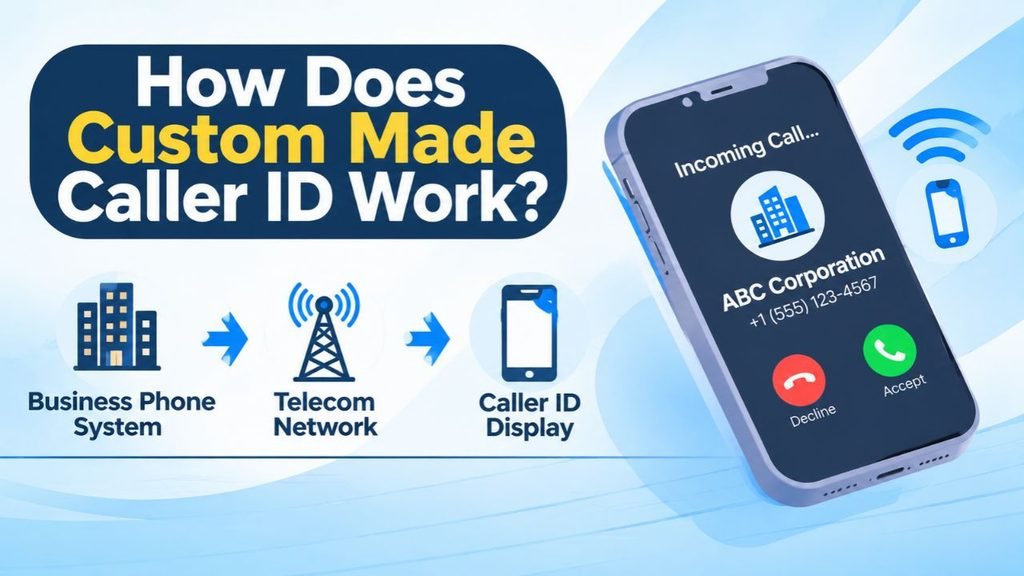
Caller identification is an important part of business communication. Customers often want to know who is contacting them before answering a call.
A properly configured Custom Made Caller ID service can provide several benefits.
1. Better Business Identification
A registered business number can help customers recognize calls from an organization.
For example, a customer who recently contacted a bank may recognize its official customer support number when receiving a follow-up call.
2. Improved Customer Communication
Businesses that use dedicated telephone numbers can organize communication across departments.
Sales, customer support, appointment management, and technical support teams can use separate authorized numbers.
This makes communication management easier.
3. Professional Business Communication
Consistent caller identification helps organizations maintain a recognizable telephone presence.
Customers can use the displayed number to identify the organization and contact its official communication channels.
4. Centralized Call Management
VoIP-based business phone systems can provide centralized control over telephone numbers, call routing, and communication settings.
This can be useful for organizations with multiple employees, offices, and customer support departments.
5. Better Call Verification
Verified caller identification can help receiving networks and customers assess whether a call is associated with an authorized telephone number.
It is important to understand that caller ID alone does not prove the identity of the person speaking. Customers should verify sensitive requests through official communication channels.
What Is the Difference Between Custom Made Caller ID and Traditional Caller ID?
Traditional Caller ID and Custom Made Caller ID both relate to identifying incoming telephone calls. However, they can differ in how caller information is configured and managed.
| Feature | Traditional Caller ID | Custom Made Caller ID |
| Number display | Provider-assigned number | Authorized configured number |
| Business identity | Depends on network records | May support business identification |
| Configuration | Usually standard phone settings | May involve business phone systems |
| VoIP support | Depends on provider | Commonly associated with VoIP systems |
| Caller name | Depends on available records | May support registered business names |
| Management | Basic telephone settings | Centralized business configuration may be available |
Neither system guarantees that a recipient will see the same caller name or number on every device.
Is Custom Made Caller ID the Same as Caller ID Spoofing?
No. Custom Made Caller ID and caller ID spoofing are not necessarily the same.
Caller ID configuration involves managing authorized telephone numbers and caller information through a telecommunications provider.
Caller ID spoofing occurs when someone deliberately makes a call appear to come from a different telephone number or identity.
There are legitimate and unauthorized uses of caller identification technology. For example, a business may display its verified main office number when employees call customers from an approved business phone system.
However, using another person’s number, impersonating a bank, hiding the real origin of a call, or misleading recipients can violate telecommunications laws and regulations.
In the United States, the Truth in Caller ID Act restricts knowingly transmitting misleading or inaccurate caller ID information with the intent to defraud, cause harm, or wrongfully obtain something of value.
Businesses should use numbers they own or have explicit authorization to present. They should also follow the telecommunications regulations applicable to their operating countries.
Who Needs Custom Made Caller ID Services?
Custom Made Caller ID and related business caller identification services can be useful for organizations that make regular outbound calls.
Common users include:
Small Businesses: Companies that contact customers about products, services, appointments, and support.
Call Centers: Organizations that manage large volumes of customer communication.
Customer Support Teams: Departments that contact customers about complaints, technical problems, and service updates.
E-commerce Businesses: Online stores that communicate with customers about orders, deliveries, and returns.
Healthcare Organizations: Authorized healthcare providers that contact patients about appointments and administrative matters.
Financial Institutions: Organizations that use verified business telephone numbers for legitimate customer communication.
The appropriate service depends on call volume, business requirements, geographical coverage, and provider support.
How to Choose a Custom Made Caller ID Provider
Choosing a telecommunications provider requires checking its technical capabilities, security practices, pricing, and regulatory compliance.
Before selecting a Custom Made Caller ID service, consider the following factors.
First, check whether the provider supports your country and the telephone networks you need to reach. Caller identification features can vary between countries and mobile operators.
Second, confirm its number authorization requirements. A reliable provider should explain what documents or permissions are required to use a business telephone number.
Third, review its VoIP and SIP compatibility if you operate an internet-based business phone system.
Fourth, ask whether the provider supports business caller name registration and number authentication. These are separate features and may require different processes.
Finally, check its pricing, technical support, call quality, security policies, and terms of service.
A legitimate provider should explain its caller identification capabilities without promising guaranteed display across every telephone network.
Frequently Asked Questions (FAQ)
What is Custom Made Caller ID?
Custom Made Caller ID refers to a caller identification configuration that allows businesses and authorized users to manage the telephone number and supported caller information displayed during outbound calls.
How does Custom Made Caller ID work?
It works through telephone network signaling and caller identification systems. An originating phone system sends authorized caller information, and the receiving network processes the information before displaying supported details on the recipient’s device.
Does Custom Made Caller ID require VoIP?
Not always. However, many modern business caller identification services use VoIP technology because it supports centralized call management and flexible telephone configurations.
What does CLI mean in caller identification?
CLI means Calling Line Identification. It refers to the telephone number associated with an incoming call and transmitted through the telecommunications network.
What is the difference between CLI and CNAM?
CLI identifies the calling telephone number, while CNAM refers to the associated caller name. Both can contribute to caller identification, but their availability depends on the telephone network and service provider.
Can Custom Made Caller ID display a business name?
Yes, supported systems can display registered or verified business names. However, the receiving carrier, device, and caller identification database determine whether the business name appears.
Is Custom Made Caller ID legal?
It can be legal when used with authorized telephone numbers and in compliance with applicable telecommunications regulations. Misleading recipients, impersonating others, or transmitting unauthorized caller information may violate laws.
Is Custom Made Caller ID suitable for small businesses?
Yes. Small businesses can use authorized business caller identification to maintain consistent communication with customers, manage outbound calls, and establish a recognizable telephone presence.
Can caller ID information be verified?
Yes. Certain telephone networks support caller authentication technologies such as STIR/SHAKEN. These technologies help verify calling number information but do not guarantee the identity of the person making the call.
Conclusion
Custom Made Caller ID is part of modern business communication and telephone identification technology. It helps organizations manage authorized outbound caller information through traditional telephone systems and modern VoIP infrastructure.
Technologies such as SIP, CLI, CNAM, and STIR/SHAKEN support different parts of the caller identification process.
For businesses, properly configured caller identification can improve business recognition, support customer communication, and make telephone management more organized.
Before choosing a Custom Made Caller ID service, businesses should check number authorization, network compatibility, caller name support, security, and local telecommunications regulations. Using verified business information and authorized telephone numbers is essential for reliable and responsible communication.